Perpetual Attention Markets

michaellwy
@michael_lwy (opens in new tab)- Published on
- · 8 min read
Have thoughts on this topic? Join the conversation on X.
Introduction
Prediction markets reward people who know things the crowd hasn’t priced in. But most of the time people don’t have that edge. What almost everyone does have a pulse on is online trends. If you spend any time on social media, you likely have an ambient sense of “where the timeline is leaning.”
Trendle is a prediction market around that broader intuition. It transforms online attention into a new financial asset class. It allows users to speculate on the rise and fall of sentiment and engagement around topics like crypto narratives, sports teams, celebrities or political events.
At the heart of the platform are Attention Indexes, a proprietary instrument that measures mindshare by aggregating public engagement from sources such as X, Reddit, and YouTube. Trendle operates as a narrative perpetual market, where users can long or short the attention index of specific topics.

Attention Supply Chain
Attention is the only scarce resource in the digital age as everything else keeps expanding towards abundance. Information and content are infinite, tools to create, remix, and amplify are mostly free and accessible. The bottleneck is now perception as every actor in the attention economy competes for the same fixed pool of cognitive bandwidth.
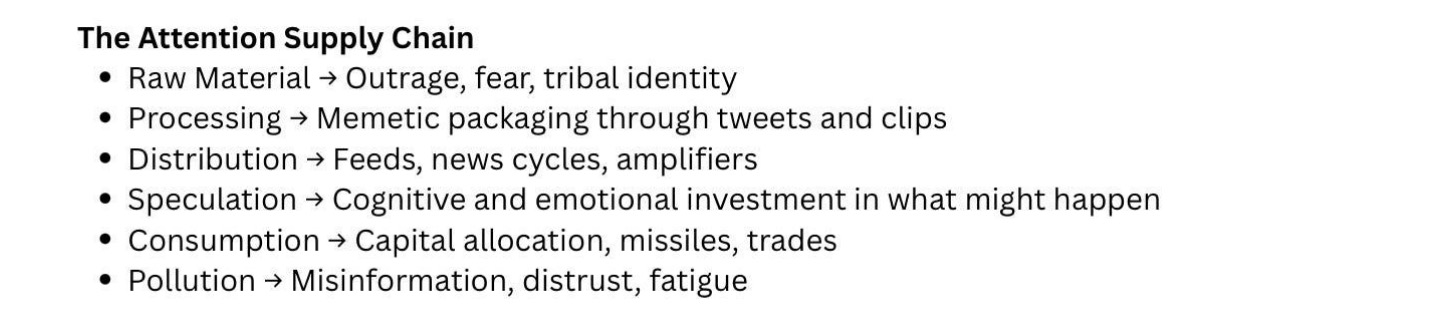
Source: Kyla Scanlon
Kyla Scanlon’s “attention supply chain” is a useful framing. Outrage, novelty, and identity form the raw inputs. Then, memes, clips, and short-form packaging turn them into digestible units. Feeds and news cycles push them into circulation. People subsequently start projecting forward, investing emotionally or financially in where the narrative might go. Those projections drive actions in markets and culture.
If attention is truly a scarce commodity with an identifiable supply chain, then it follows that it can be quantified, priced, and traded like any other resource. Trendle is a protocol built on that premise. It builds an index that tracks where attention is moving and a market where people can trade on that movement.
Creating the Attention Index
The naive implementation would be to rely on strictly quantifiable metrics like the number of posts. For example, X has a feature called Radar that tracks how many posts mention a keyword. If you built a market directly on that metric, it would be trivial to game. Anyone could spin up bots to generate thousands of posts and artificially pump their positions.
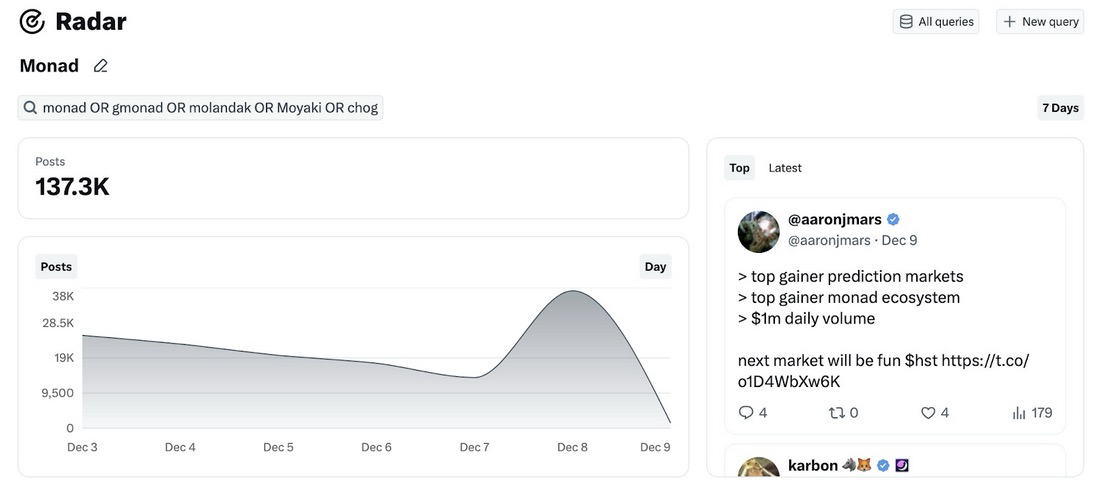
X Radar Function
Trendle is aware of this. For attention to function as a credible underlying, the index must be robust, trustworthy, and resistant to manipulation. It has to avoid Goodhart’s law, which states “when a measure becomes a target, it stops being a good measure.”
The first line of defense Trendle uses is diversification of its data sources. Instead of relying solely on metrics from one platform, Trendle ingests data from X (Twitter), Reddit, and YouTube. In the future, it will also expand to include Google Search signals.
Each of these platforms has its own incentive structures, user behaviors and its own anti-spam detection systems. Manipulating one platform might already be costly. Manipulating several at once, in a coordinated way that produces a consistent attention signal, is much harder. The wide range of inputs raises the cost of manipulation and acts as a deterrent to sybil activity. From these sources, a variety of user actions are fed into the data engine, such as:
- Reddit: post count, upvotes and downvotes, comments, average score, hot posts, velocity of mentions, etc.
- YouTube: views, view-weighted likes, view-weighted comments.
- Twitter: retweets, bookmarks, impressions, quotes, replies.
The next step after ingesting the data is converting them into a stable, comparable per-topic Engagement Index through normalization. It puts every metric on the same 0–1 scale, trims extreme outliers, and smooths noise so the final index reflects real shifts in engagement rather than randomness.
To further enhance robustness, Trendle implements deseasonalization, which checks whether a topic’s virality is simply a recurring seasonal spike. For example, a sports team’s attention always spikes on game day but that shouldn’t count as a true breakout unless the spike exceeds its usual baseline. Other techniques like exponential decay and quantile clipping add to robustness.
Turning attention into an asset class’ is easier said than done. There are real technical challenges that must be solved for the index to measure how much mindshare a topic, person, or event captures online. The true goal here is to create a proxy that reflects more qualitative factors of attention such as hype, momentum, and controversy.
It is likely that the attention index will not be perfect in the beginning. If the financial reward for gaming the system is large enough, manipulators will still find ways to exploit metrics. As the experiment goes live, Trendle must adapt accordingly to ensure that the index remains trustworthy among users by incorporating more diverse data sources (TikTok, news media, etc.) and other statistical safeguards.
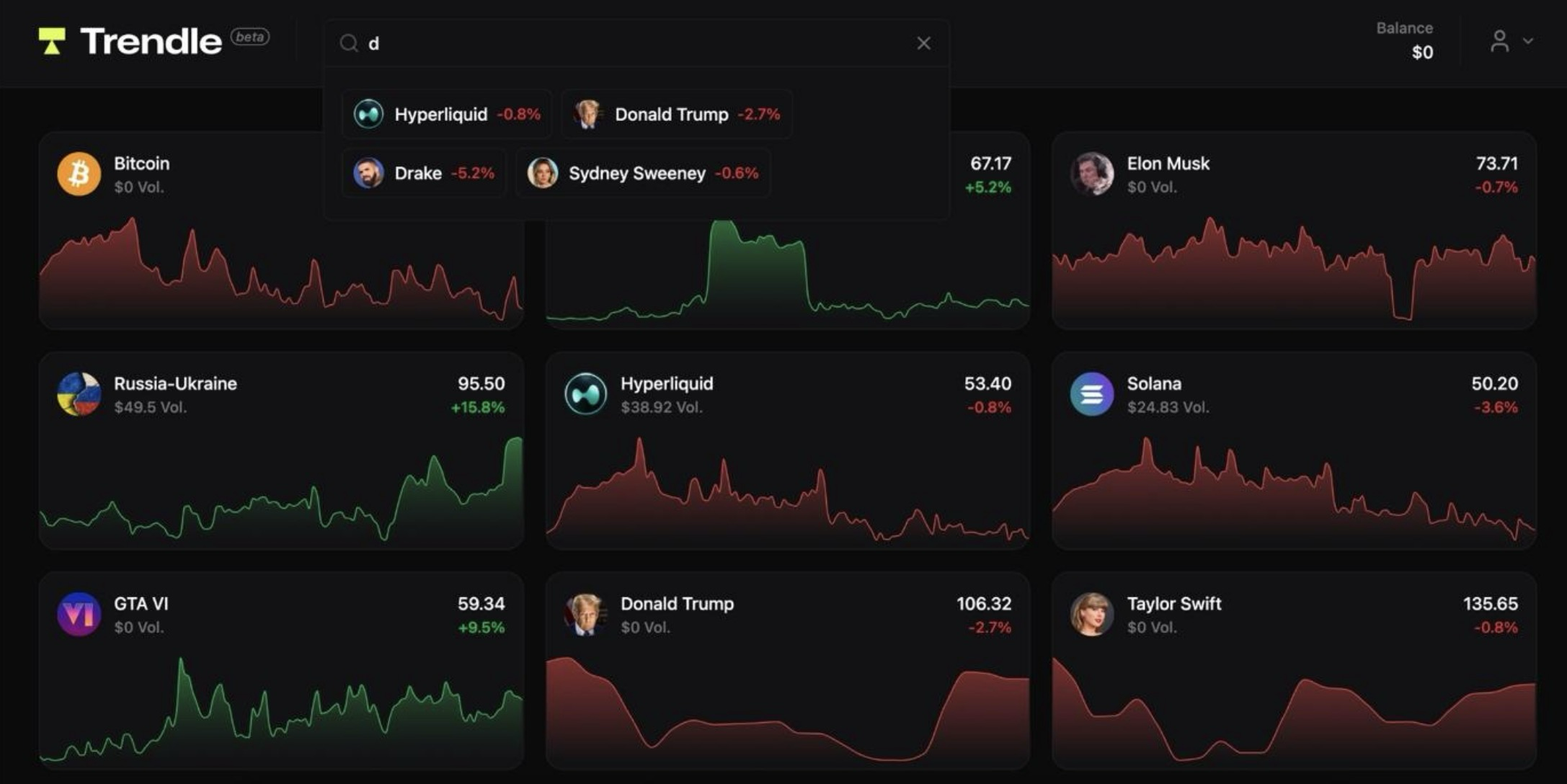
App Demo
Trading the Attention Index
Trading the attention index on Trendle is simple. You pick a topic card, choose whether you think the attention index on it will go up or down, put in the trade amount and make a prediction.
Leverage (up to 5x) is allowed. This makes the trading experience similar to a perpetual futures exchange. There is a funding rate, and users with leverage will be liquidated if their margin falls below a maintenance level.
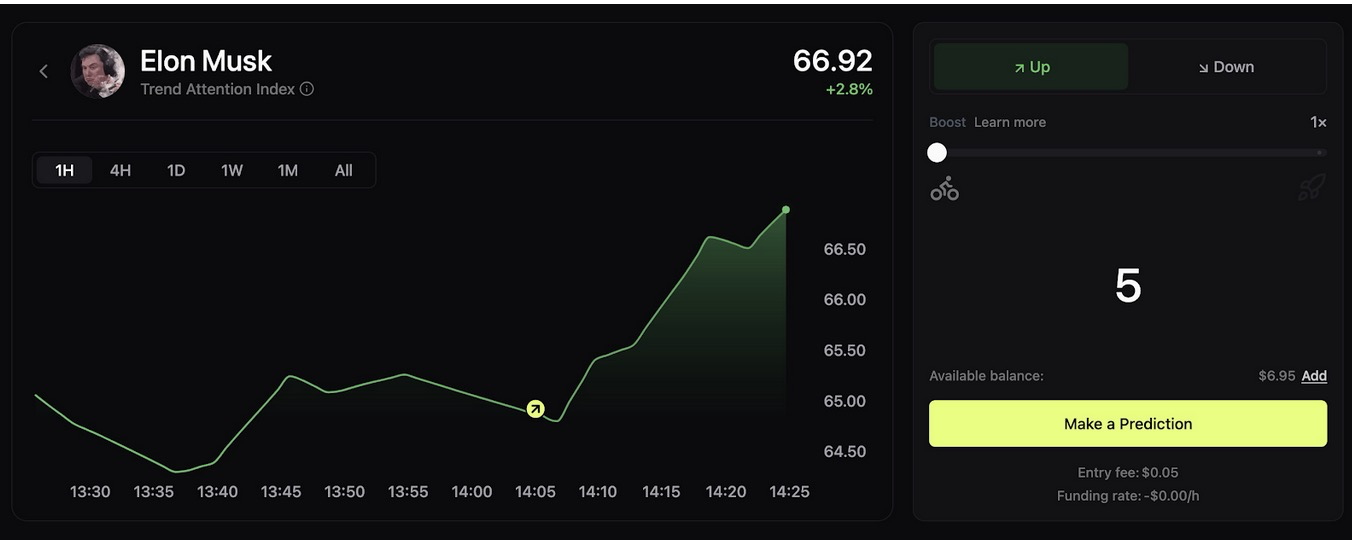
App Demo
The funding rate in Trendle has a slightly different purpose than in perpetuals. In perps, funding rates exist to keep the perp price close to an external oracle spot price. The funding rate acts as a correction force to nudge traders to take the side that brings the perp price back to the oracle.
There is no tradable “spot attention asset” to arbitrage against. Instead, Trendle separates the system into two distinct layers:
- The index layer, where the attention index is computed from social and engagement data, independent of trader positioning.
- The market layer, where traders price a perpetual-style derivative around that index based on risk appetite, leverage, and positioning.
Since there is no external spot price as reference, the funding rates on Trendle serve as a ‘crowding tax’ to penalize the crowded side and reward the minority side. This leads to an important point about trading on Trendle.
When a topic blows out and goes viral, you might expect that easy money can be made because you can just bet on it to continue going up. Trendle rewards the trader who understands the difference between “this narrative is rising” and “this narrative is already fully priced in by positioning.” The funding rate is an important element that seeks to incentivize the right user behavior.
A crowded long does not mean the topic index won’t go up. But it does mean the cost associated with maintaining a position in that direction will go up. The index can still rise and you can still profit, but you are paying a high continuous fee for being on the same side as everyone else. The most obvious trade becomes more expensive to hold.
At the same time, the minority side becomes attractive when the narrative is overextended. If attention is peaking, shorts earn funding and benefit from any slowdown. Trendle makes timing the end of hype a coherent strategy.
Trendle’s system rewards traders who detect shifts in attention before the crowd or who recognize when hype exhaustion is near. It penalizes those who simply follow momentum without understanding positioning. That is how the system stays fair and liquid.
Conclusion
Prediction markets financialized information. Trendle extends that logic to attention itself, treating narrative intensity as something that can be measured, priced, and traded. The core question is whether attention can function as a reliable financial primitive.
If the system works as intended, it offers traders a new surface area. The opportunity lies in whether Trendle can become the reference venue for attention pricing in the same way that prediction markets became the reference venue for probabilistic pricing of events. Execution quality, index credibility, liquidity depth, and the platform’s ability to resist gaming will determine how far this model scales.