Why Valos & Accountable Launched the Institutional Credit Vault on Monad

Monad Foundation
@monad (opens in new tab)- Published on
- · 7 min read
TLDR:
- Valos launched an institutional credit vault on Monad using Accountable's verification layer and Agora's AUSD for deposits and withdrawals.
- As of the end of April, total TVL in the credit vault sits at over $110M.
- The value proposition: investors can check where capital is deployed and monitor borrower health continuously, instead of waiting for quarterly reports.
- Continuous verification demands sub-second infrastructure. In credit, delays create operational ambiguity: do you treat funds as settled or not?
- Monad's ~400ms blocks and ~800ms deterministic finality are the practical unlock points here. It makes "real-time verified" controls usable in normal workflows.
- EVM bytecode compatibility lowers integration risk. You can use familiar Ethereum tooling and contract patterns instead of rebuilding on a novel stack.
Overview
Monad is a high-performance Layer 1 blockchain purpose-built to power the financial layer of the internet. For the internet financial layer to operate effectively, it must service the needs of institutional players and capital. A key sector within institutional finance is institutional credit.
On February 17, 2026, Valos launched an institutional credit vault on Monad. The vault is built with Accountable's Vault-as-a-Service infrastructure, powered by Accountable's Data Verification Network (DVN) for solvency verification, and uses Agora's AUSD stablecoin for deposits and withdrawals.
Valos positioned this vault as "real-time verified" private credit. Allocators can continuously verify where loans are deployed and whether the borrower still looks healthy, instead of waiting on quarterly reporting cycles.
Henri Nieminen, CEO and Co-Founder of Valos, frames the problem as an operational one:
"Digital asset private credit relies on trust, but trust has to be backed by transparency. We saw the need for allocators to have real-time visibility into the underlying credit exposure – showing the loan book as it changes, not weeks after the fact."
Challenge: Continuous Verification Demands Sub-Second Infrastructure
Institutional credit poses two hard problems when businesses try to run it transparently onchain.
1) Periodic reporting can't match how credit actually moves
Accountable's Data Verification Network is designed to support continuous proof of both onchain and offchain activity while preserving privacy. Verification is done continuously rather than quarterly.
On chains where posting and reading updates is slow and/or expensive, this continuous verification would fall apart.
Wojtek Pawlowski, Co-Founder and CEO of Accountable, says they're also focused on supporting clients to maintain transparency during unexpected events:
"We're giving institutions the means to share verifiable data on reserves, liabilities, and collateral positions, so counterparties can validate exposure and financial health, including during incidents."
2) Credit operations are bursty in the real world
Credit doesn't move on an orderly schedule. Allocator flows come in bunches. Repayments show up when they show up. Collateral ratios can also change quickly when market movements are more pronounced. When that happens, operators need the system to reflect reality quickly.
If finality takes seconds or minutes, teams face a hard choice:
- Treat "almost confirmed" as confirmed and accept the risk of a transaction being undone, or
- Wait for settlement and lose the benefit of "real-time" visibility and control
This is where slow settlement forces product compromises. To reduce settlement uncertainty, builders may need to extend credit, restrict withdrawals, or delay updates.
Solution: Monad's Design Matches the Operating Model of Verified Institutional Credit
Monad is built to run high-frequency workflows on an EVM chain. The most relevant performance parameters for this case are ~400ms block times and ~800ms deterministic finality. This is settlement that operators can actually rely on. In the case of Valos and Accountable, Monad solved the following parameters:
1) Deterministic finality reduces operational ambiguity
Credit allocators need an exact answer, not "confirmed but could still change." Deterministic finality means changes in the system are considered final. In vault operations, this is essential for deposits, withdrawals, and internal accounting updates.
With predictable finality, teams can build workflows that behave like real infrastructure instead of probabilistic guesswork.
Nick van Eck, CEO and Co-Founder of Agora, believes that this is the key unlock for stablecoin based business:
"The baseline has to be there. Without institutional-grade settlement assets, you're not building financial infrastructure, you're managing uncertainty. AUSD exists to offer a secure, institutional-grade settlement flow with robust liquidity."
2) EVM compatibility lowers integration risk
Institutions don't want to rebuild systems from scratch. New runtimes and bespoke tooling can be technically impressive, yet fail in practice.
Monad is EVM bytecode-compatible and aims to work with standard Ethereum tooling and RPC expectations. The business implication is faster time-to-production and less audit surface area than moving core workflows to a non-EVM technical stack.
Implementation: What Monad Enables in this Specific Vault
The vault structure is straightforward:
- Allocators deposit AUSD (Agora's institutional-grade stablecoin)
- Valos deploys capital into institutional credit loans
- Returns are denominated in AUSD and reflected in the vault structure
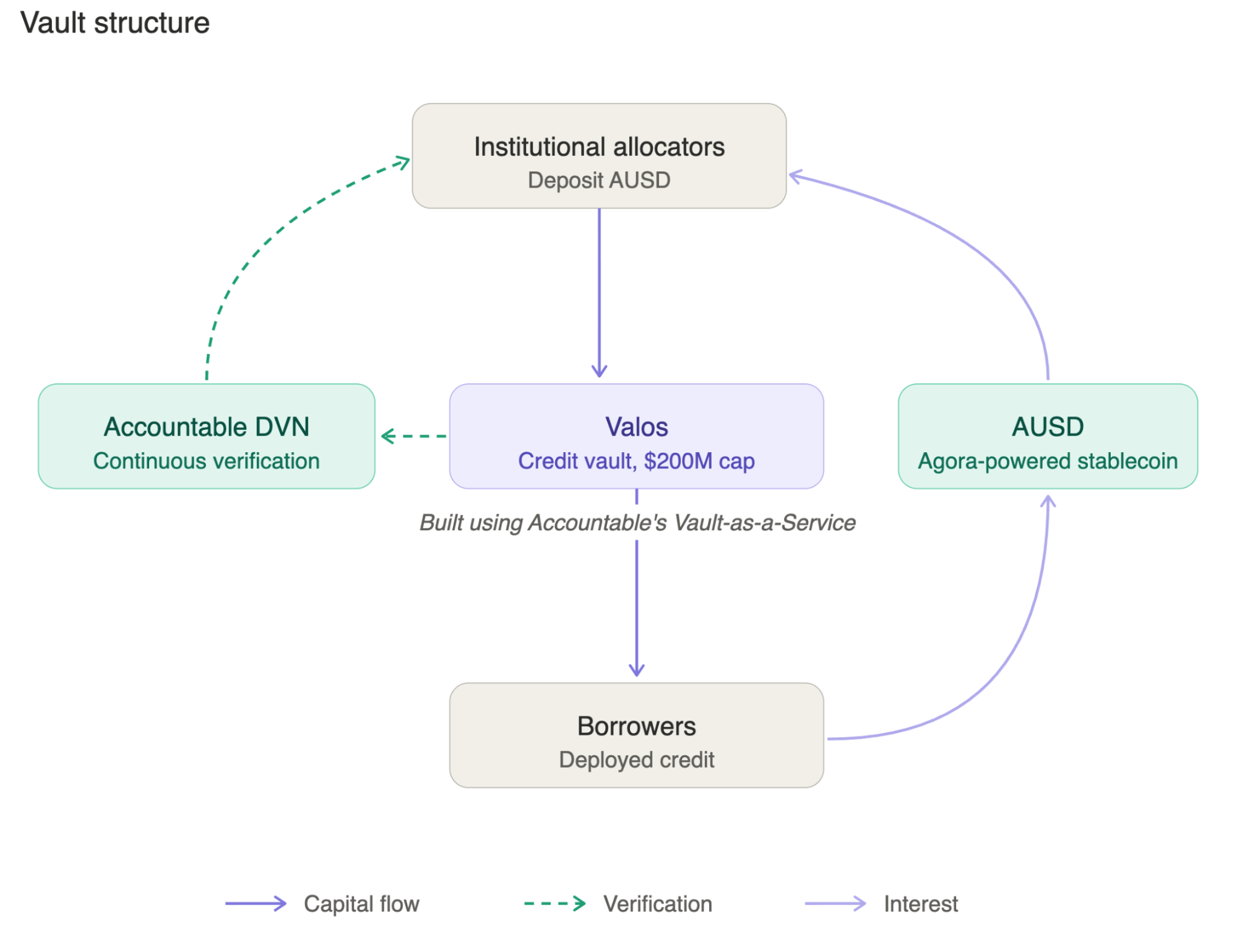
The vault is built on Accountable's Vault-as-a-Service, the framework that lets institutions like Valos structure and manage tokenized credit or yield offerings onchain. It's customizable on access rules, interest models, and collateral terms, with real-time verification via Accountable's Data Verification Network built in. From there, the vault is listed on YieldApp, Accountable's marketplace for verifiable yield, where institutional allocators can discover and assess opportunities backed by continuous verification.
This is where Monad becomes a differentiator. Those updates are time-sensitive and can only feel continuous if the chain settles quickly enough that:
- Monitoring can act without delay
- The vault can consume that data immediately
- Users can act on it (deposit, redeem, rebalance) without waiting around for uncertain settlement
Results: Institutional-Scale Launch, with Transparency as a Product Feature
What the metrics look like at the end of April:
- $1.63M of interest generated
- $113M allocated, $200M capacity (settled in AUSD)
The vault's verification can be monitored in near real time within the vault's interface under the Verification tab.
The core outcome is a higher standard of disclosure. Allocators can verify loan deployments and borrower health in real time without forcing borrowers to expose sensitive operational details.
Private credit usually trades transparency for access and returns. This integration keeps the privacy where it matters (borrower internals) while improving the investor's ability to continuously validate what's going on.
About Monad
Monad is a high-performance, institutional-grade Layer 1 blockchain purpose-built to power the financial layer of the internet. Fully EVM-compatible, Monad delivers 10,000 TPS, 400ms block times, 800ms finality, and near-zero fees — without requiring specialised hardware. The network runs on consumer-grade machines, supporting accessible participation and decentralized network operation: over 200 independently operated validators across 30+ countries and 55+ cities secure the chain today.
About Valos
Valos is a digital asset manager with particular expertise in institutional private credit. The firm provides secured lending solutions to professional allocators, with an emphasis on risk management, transparency and capital preservation. Valos manages one of the largest active institutional loan books in digital asset private credit, with long-standing counterparties across the ecosystem, including tier-1 market participants. Its credit strategies are supported by disciplined underwriting, continuous risk monitoring, and experience operating through different market cycles. Learn more at www.valos.io
About Accountable
Accountable is the new standard for real-time financial verification that allows institutions to prove assets and liabilities privately. Built for both traditional and crypto-native markets, the platform enables counterparties to demonstrate financial health without exposing sensitive details like API keys, wallet addresses or trading strategies. At its core is the Data Verification Network, a privacy-preserving system that powers real-time proof of both onchain and offchain activity. On top of the Data Verification Network, Accountable offers Vault-as-a-Service, a framework for structuring and managing capital onchain, and YieldApp, the first marketplace built on Data Verification Network, surfacing verifiable return opportunities. Learn more at www.accountable.capital
About Agora
Agora is a leading stablecoin issuer and infrastructure provider to enterprises. AUSD, Agora's enterprise-grade stablecoin, is widely used across trading, payment, treasury, lending, and third-party applications. Learn more at www.agora.finance