Monad: The Home of High-Frequency Finance

Monad Foundation
@monad (opens in new tab)- Published on
- · 8 min read
As the world becomes increasingly efficient and global, businesses are realizing that legacy systems do not meet the demand of modern users. Bank wires can take two to three days to settle and even during periods of extreme volatility, equities markets are not open on the weekends. Despite a 24/7 global economy servicing the needs of constituents around the world, existing financial rails and systems do not operate to reflect this reality. Modern day payments, institutional FX, and derivatives are all held back by the same thing: infrastructure that wasn't built for the speed the internet already operates at.
Monad was built to close this gap. It is a high-performance blockchain designed to enable high-frequency finance, providing the ability to move and manage assets instantly, reliably, and in size. On Monad, payments clear in milliseconds, trading venues operate without interruption, and financial markets function without intermediaries or business hours.
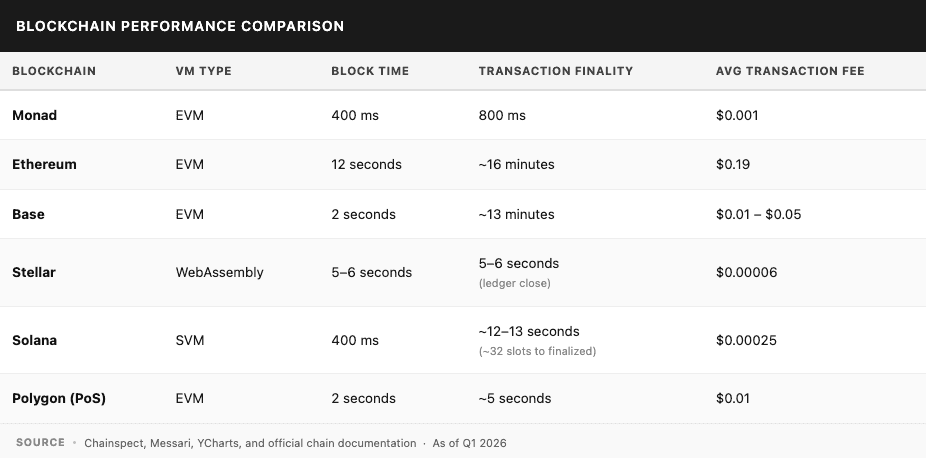
Founded by former high-frequency traders from Jump Trading, where the team moved over $1 trillion in notional volume annually, the engineers behind Monad applied that same obsession with micro-efficiency to open, borderless settlement. The chain delivers 10,000 TPS, 400ms block times, and 800ms deterministic finality at near-zero fees, running on a decentralized network of 170+ validators across 30+ countries, with full EVM compatibility.
For institutional finance, network reliability is as critical as performance. Since Monad launched in November 2025, there has been no reported downtime. If a validator drops out of the diverse validator network, the chain keeps moving. MonadBFT requires a supermajority of validators to reach consensus, so no single node can halt the network. If block production stalls, the consensus mechanism has a built-in recovery process that restores block production without a restart.
Since mainnet launch, the chain has processed over 130 million transactions, $6.5 billion in DEX volume, and attracted 2.3 million active users across 125+ live applications. Where traditional financial rails are defined by bottlenecks and slow processes, Monad's architecture enables a new class of high-frequency finance use cases.
Onchain Trading
Historically, DeFi exchanges relied on automated market makers (AMMs) that price assets algorithmically from liquidity pools. AMMs were a necessary workaround because real order books need constant transaction flow, and most chains lacked the throughput to support that onchain. Monad removes that constraint, making fully onchain central limit order books (CLOBs) viable in the EVM for the first time.
Kuru, backed by $13.6 million in total funding led by Paradigm, is among the first protocols to deploy this model in production. Kuru has built a hybrid CLOB-AMM exchange where traders receive limit order precision with always-on AMM liquidity, settling fully onchain. Market makers can place and cancel limit orders at a constant, low gas cost, enabling tighter spreads and better price discovery than AMM-based alternatives. Kuru Flow, the protocol's smart aggregator, routes trades across all available liquidity on Monad, giving traders reduced slippage and more efficient execution in a single interface.
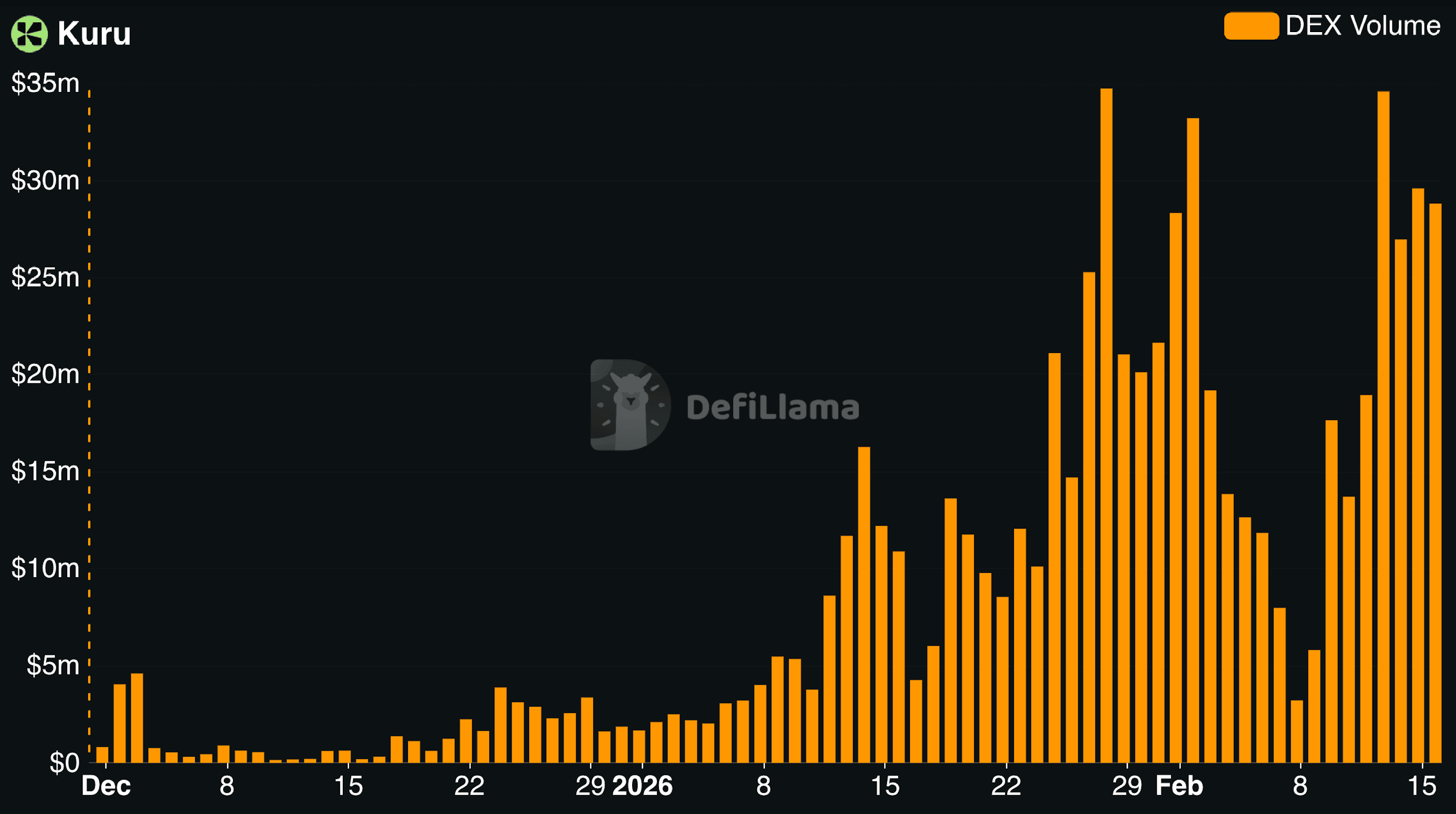
Kuru daily DEX volume (USD $M) since Dec 1, 2025
The same infrastructure constraints that limited spot trading have historically made onchain perpetuals even more difficult to solve. Building a fully onchain perpetuals DEX with a CLOB was widely considered impossible. Every prior generation of blockchain infrastructure forced a compromise: off-chain order matching on Ethereum L1, AMM-based perps on L2s, or centralized sequencers on app-chains. Each approach sacrificed either decentralization, composability, or execution quality.
Perpl, which launched on Monad on February 24, 2026, is the first perpetuals DEX to achieve fully onchain execution, a central limit order book, and the gas efficiency required for viable market making, all on a decentralized L1. At 500 million gas per second with 20% blockspace, Perpl can process 1,000 post-and-cancels per second, with realistic headroom to push nearly 5,000. It costs market makers roughly $0.0001 per post-and-cancel, making onchain market making economically and technically viable at institutional scale. Something that was not possible before Monad.
Onchain Foreign Exchange
The foreign exchange (FX) market moves over $9.6 trillion in volume on a daily basis. It is the largest and most efficient traditional financial market in existence with tight spreads, deep liquidity, and prices updating constantly. FX price discovery operates at a speed that blockchain infrastructure historically couldn’t accommodate. When block times cannot keep pace, quotes go stale, spreads widen, and execution quality deteriorates.
Mento, an onchain FX protocol supporting 15 currencies with $18.5 billion in trading volume in 2025, has deployed on Monad to bring institutional-grade currency markets onchain. Rather than AMM curves that distort pricing on large trades, Mento uses oracle-based reference rates to ensure traders are quoted prices that track real exchange rates. That model demands constant price updates and deterministic settlement, requirements that Monad's sub-second finality is built to meet.
However, currency exchange infrastructure addresses only one dimension of onchain FX markets. The other is having a stable, yield-bearing asset to hold on the other side of trades. Etherfuse addresses this directly and is building government bond market infrastructure on Monad, tokenizing sovereign debt such as Mexican CETES, Brazilian Tesouro, and UK Gilts into yield-bearing onchain assets with strong local fiat on/off ramp relationships. Together with Mento, users can hold local currency bonds earning real government yield and swap into other currencies around the clock. Unlike traditional FX and bond markets, which operate on restricted hours and multi-day settlement cycles, these markets are accessible and settle without delay on Monad.
Onchain Institutional Private Credit
Institutional capital requires the same performance standards as trading infrastructure. Valos recently launched the first institutional private credit vault on Monad to meet that standard, with $100 million in initial allocations and $200 million in capacity. The vault is built on Accountable's Data Verification Network and powered by Agora's AUSD stablecoin. Valos manages over 50 active loans and has deployed more than $1 billion to tier-1 crypto market makers. Depositors contribute AUSD, Valos deploys that capital into credit loans to institutional market makers, and yield is generated from interest on those loans.
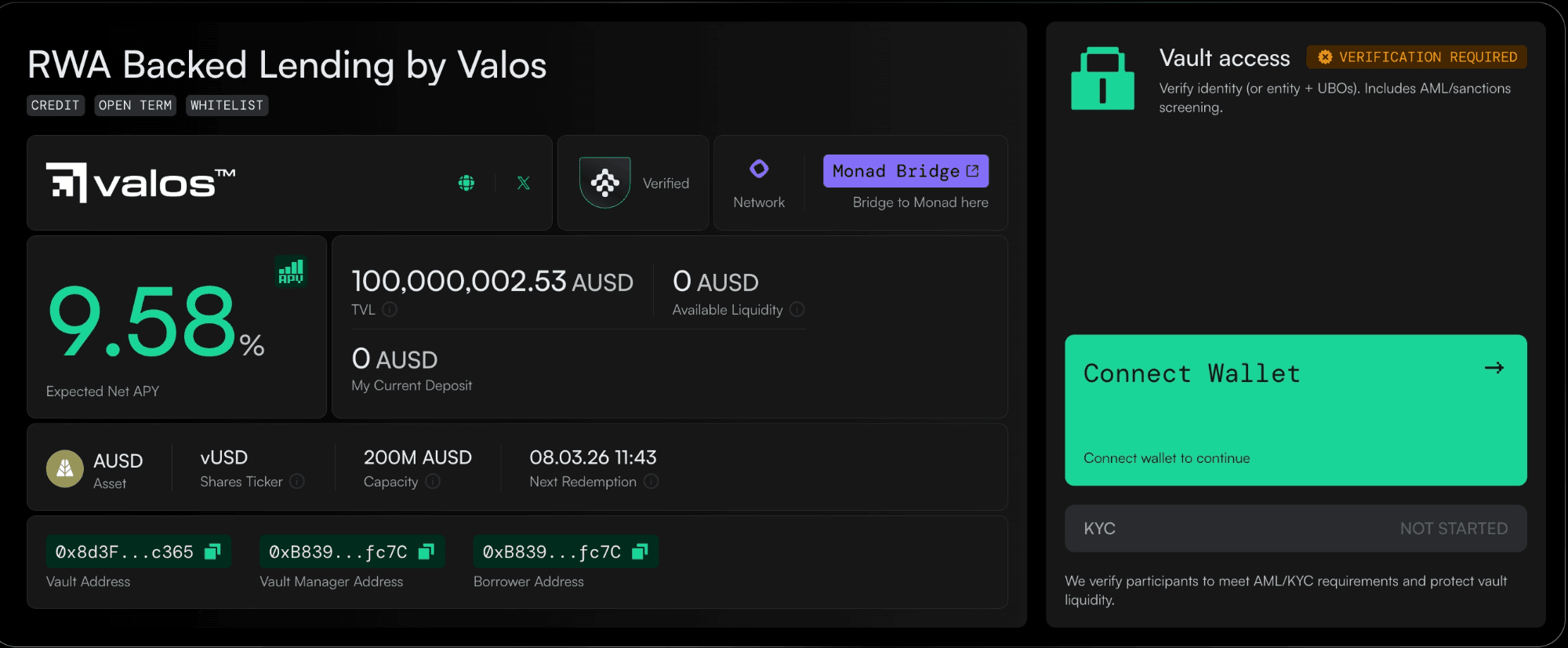
The Valos vault on YieldApp, live on Monad
In traditional credit markets, institutional allocators relied on quarterly reports and snapshot audits that were outdated by the time they were published. This vault provides real-time visibility into proof of underlying reserves, live collateral ratios, and counterparty exposure across active loans, all while borrower privacy is preserved. Transparency at this level requires infrastructure that operates continuously and settles without delay. Monad's architecture is designed to meet both requirements.
Onchain Payments
Global payment infrastructure has not kept pace with the demands of modern commerce. Domestic rails like ACH and Fedwire process in batches, operate within fixed business hours, and are confined to a single jurisdiction. Cross-border payments route through correspondent banking networks that take days to settle and charge significant fees at each intermediary step.
Stablecoins present a credible alternative, but only if the underlying chain can meet the timing requirements of real-world payment systems. Card authorization windows operate in milliseconds. Merchant settlement cycles require finality, not probabilistic confirmation. Treasury operations demand predictable execution under load. Most blockchains cannot meet these requirements, but Monad's sub-second deterministic finality and consistent execution under load make it the infrastructure that stablecoin payment flows require at scale.
USDC launched on Monad on day one of mainnet, and stablecoin supply has since grown to over $410 million. Over 20 fiat on/off ramps support Monad across cards, bank transfers, and ACH, providing coverage across North America, Europe, LATAM, Africa, and APAC. Zerohash, a crypto infrastructure company backed by Interactive Brokers and valued at over $1 billion, integrated Monad to power stablecoin payment flows for enterprise clients including Kalshi and Gusto. On the consumer side, Bidali enables users to spend stablecoins directly at thousands of merchants worldwide through gift card redemption across major global brands.
Taken together, these integrations reflect a payments ecosystem that functions reliably at the speed that institutional and consumer use cases both demand. This is why money moves on Monad.
The Bigger Picture
The institutional infrastructure is already here. Fireblocks, Anchorage, and Coinbase all integrated with the Monad network at mainnet launch. Chainlink powers the oracle feeds that keep pricing accurate across the ecosystem, the same infrastructure underpinning Mento's FX rates.
Payments, FX, trading, lending, and tokenized assets each operate differently, but share the same requirements: fast settlement, low fees, and infrastructure that does not go offline. Monad provides the settlement speed, cost efficiency, and operational continuity that each of these markets requires.
The future of finance is high-frequency finance, and it is here today.
About Monad
Monad is a high-performance, EVM-compatible Layer-1 blockchain designed for high-frequency finance. It delivers up to 10,000 transactions per second, sub-second finality, and low transaction fees. Its architecture enables more efficient payment flows and other transaction-intensive financial use cases by reducing latency and improving throughput while maintaining compatibility with established Ethereum standards. Monad is operated by a decentralized, globally distributed validator network and provides secure, scalable infrastructure for onchain financial activity at scale.