Streaming Payments with Stablecoins: Rethinking How Payroll Solutions Pay People

Harry Alford
@HarryAlford3 (opens in new tab)- Published on
- · 6 min read
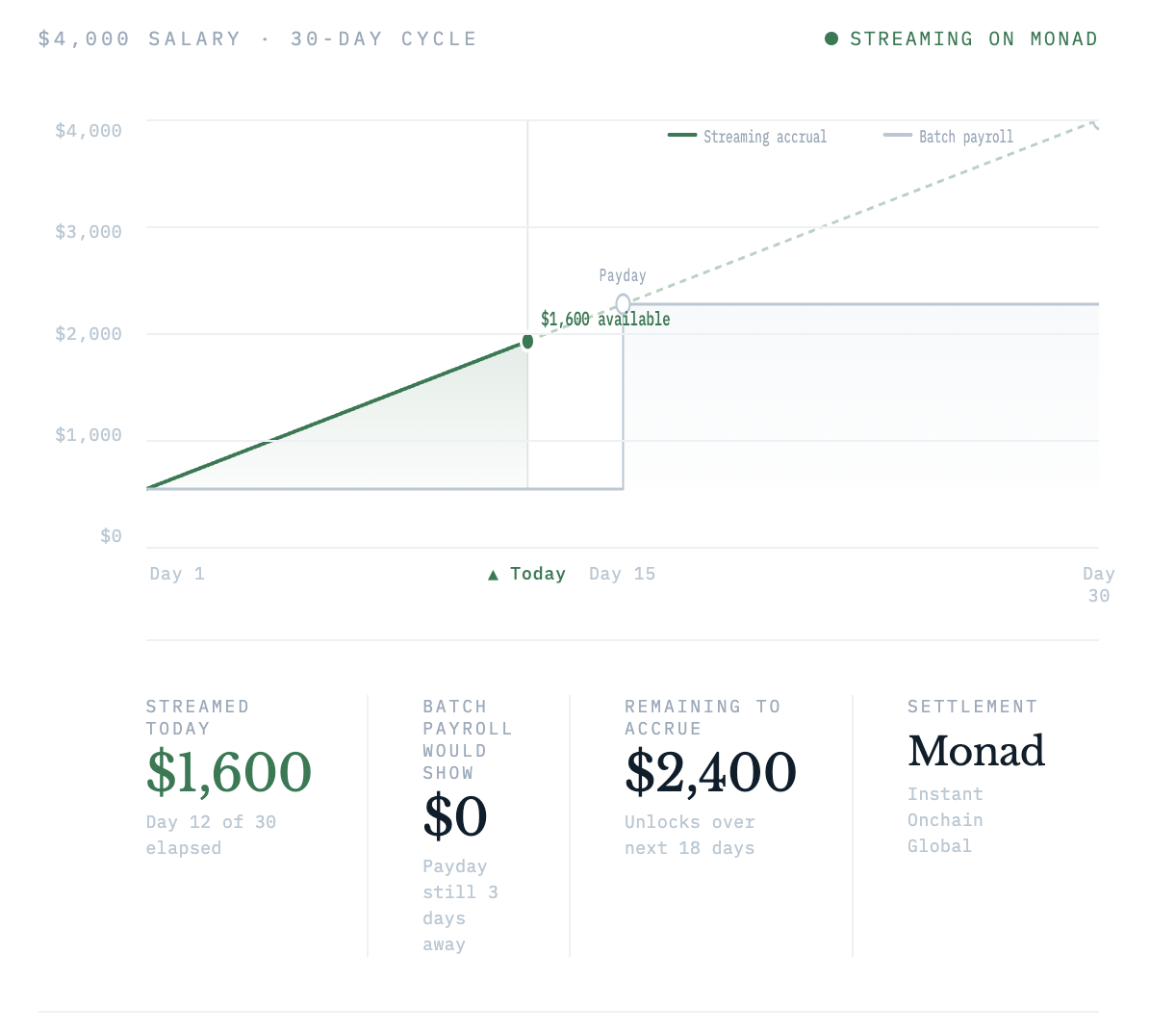
Payroll has quietly gone through a massive digital transformation over the last decade. Direct deposit is now the default. Onboarding is API-driven. Most payroll and HR stacks live in the cloud. But one assumption hasn’t really been questioned. People are still paid in lumps, every two weeks or once a month, even though the value they create is continuous.
Work doesn’t happen on the 15th and the 30th. It happens every day, sometimes every minute. Yet the financial infrastructure that supports payroll is still built around batch settlement systems like ACH and their equivalents worldwide (only a few offer on-demand payment options for contractors).
Most professional employer organizations and payroll platforms, such as ADP, JustWorks, and many more, run payroll as scheduled events because that’s what the underlying rails require. Funds move at the end of a pay cycle. But what if payroll wasn’t an event at all? What if, at the start of a pay cycle, an employer funded payroll in stablecoins and initiated a continuous payment stream instead of preparing a future bank transfer?
In that model, an employee’s salary wouldn’t arrive every two weeks. It would accrue in real time. Access to income would become a function of time rather than a function of when a batch process executes.
The fact that whole products now exist just to handle stablecoin payroll is a useful indicator that employers and workers are already willing to move off traditional rails when it offers them faster, more flexible payouts. A few stablecoin payroll options include Franklin, BVNK, Rise, and Toku.
Streaming payments take that same energy one step further by changing not just which asset is used for payroll, but how it moves in the first place.
What Are Streaming Payments?
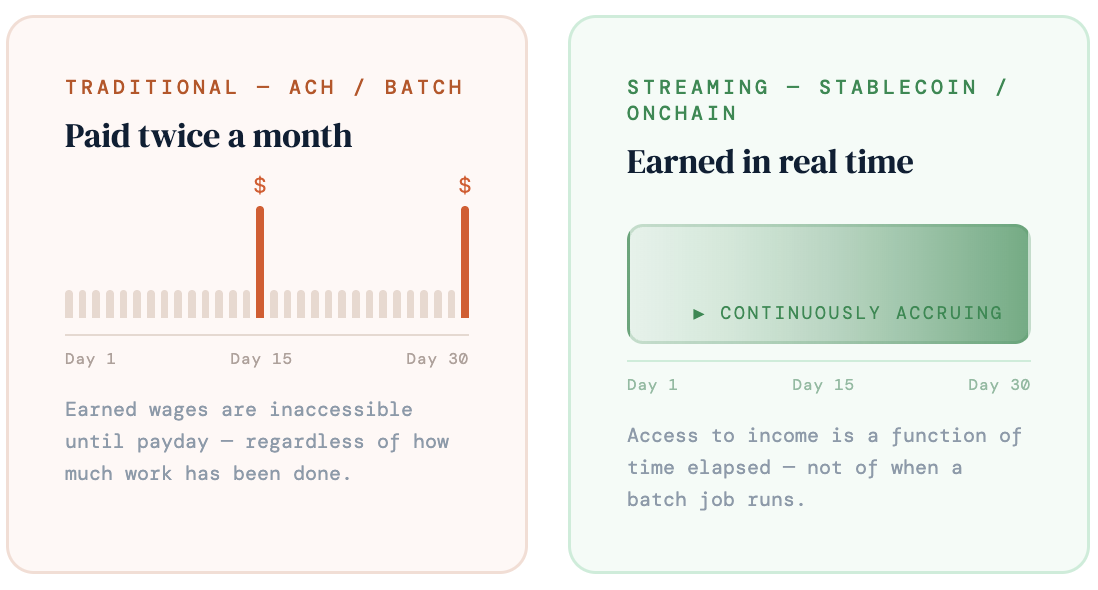
Streaming payments are a way to turn a fixed payment into a continuous, programmable flow of money over time, with the recipient’s earnings accruing second by second in an employee's wallet.
Instead of thinking in terms of paychecks that drop on specific dates, streaming treats income as a constant flow. It’s a small conceptual shift that unlocks very different product and UX possibilities.
Several protocols are already building streaming payment infrastructure. Zebec is a blockchain-based solution that aims to replace traditional batch payment systems, enabling streaming payroll where employees receive funds in real-time, improving cash flow, and eliminating the wait for bi-weekly paychecks.
Sablier takes a more composable approach. It's a fully onchain, open protocol that works natively with any ERC-20 stablecoin across any EVM-compatible chain, as well as Solana. Every Sablier stream is represented as an NFT, which means streamed income can be borrowed against, routed into yield strategies, or plugged into other DeFi protocols without interrupting the payment flow. Because it's an open protocol, it can also be integrated programmatically by payroll platforms, fintechs, or even AI agents that autonomously manage payment flows.
For payroll solutions, streaming doesn't need to replace the core system. It adds a new payout rail on top. A payroll provider can continue to handle taxes, filings, and compliance as usual while offering stablecoin streams as an optional payout method for employers and employees seeking real-time access. You can expose a clean API for income streams that other fintechs can build on, turning payroll from a back-office function into a platform.
Once you understand the basic idea, the next question is how this actually works in practice, especially in an onchain, smart-contract-based system.
How Streaming Conceptually Works
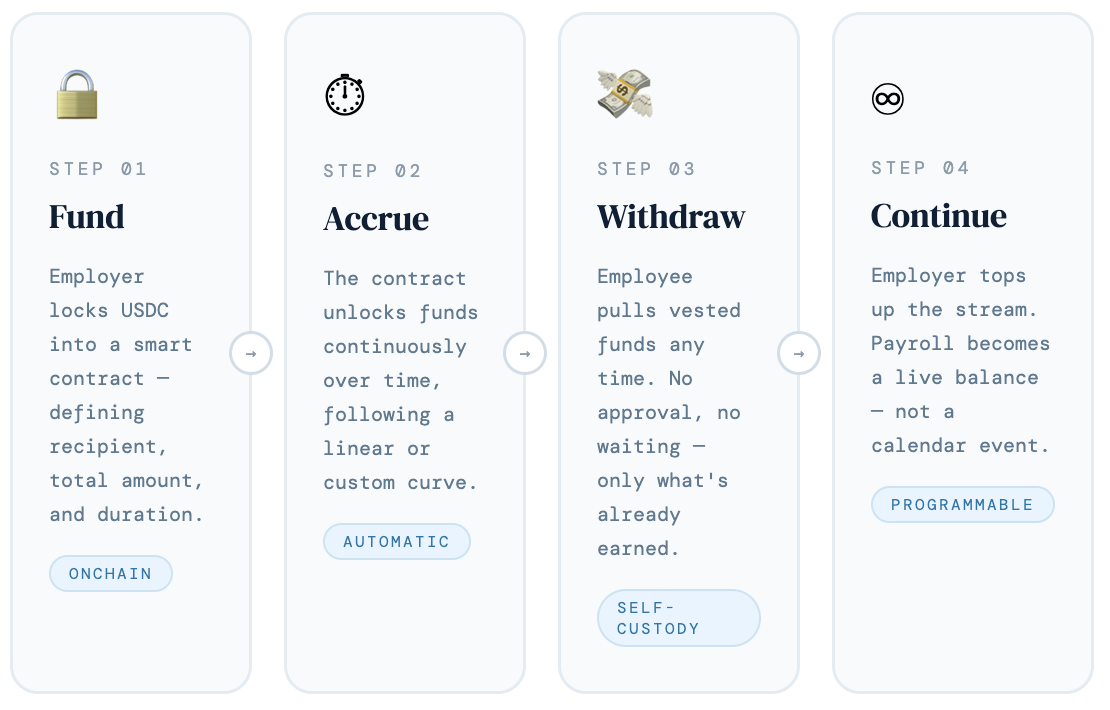
So, how would a company like Gusto integrate streaming payments into its workflow? Using a protocol like Sablier as the model, a stream looks roughly like this:
- Create a stream
A payer locks funds into a smart contract and defines:- Who is paid (recipient address)
- How much in total (e.g., $2,000 USDC/MON)
- Over what time (e.g., 30 days)
- According to a curve (linear, monthly unlock, exponential, etc.)
- Accrual over time
Once started, the contract continuously tracks how much of that payment has vested based on:- Start time
- Current time
- The chosen curve and duration
- Withdrawal by the recipient
Over time, funds become withdrawable. If 40% of the pay period has elapsed, up to 40% of the salary can be accessed (excluding any amounts already withdrawn). The recipient “pulls” funds from the stream whenever they want, rather than waiting for a single push at the end. - Completion or continuation
When the cycle ends, the full amount vests; alternatively, the stream can simply continue and be topped up, allowing payroll to run continuously rather than periodically.
For a payroll platform, supporting this kind of streaming model turns what used to be manual, one-off contract hacks into a first-class payout system: pre-fund once, stream over time, and let both sides observe and control the flow in real time.
Once you have this primitive, you can start mapping it onto familiar real-world use cases to see where it’s most powerful. Once cash flows are continuously updated, they stop being just payouts and become financial infrastructure that other systems can build on. That’s where doing this onchain starts to matter.
What makes streaming payments powerful isn't just real-time access to income; it's everything you can do with that stream once it's onchain. At Sablier, every stream is represented as an NFT, which makes it a composable financial primitive by default. Your salary isn't just sitting there: it can be borrowed against, routed into yield strategies, or plugged into other protocols without ever interrupting the flow of income. Payroll stops being a one-time transaction and becomes a building block for personal financial infrastructure. — Paul Razvan Berg, CEO at Sablier
The same mechanism that powers streaming payments naturally extends beyond payroll. The payment can be plugged into DeFi primitives because it’s onchain. For instance, employees can deposit any amount into vaults like Morpho or savings strategies, so streamed funds are automatically earning yield instead of sitting idle.
Payroll as infrastructure, not an event
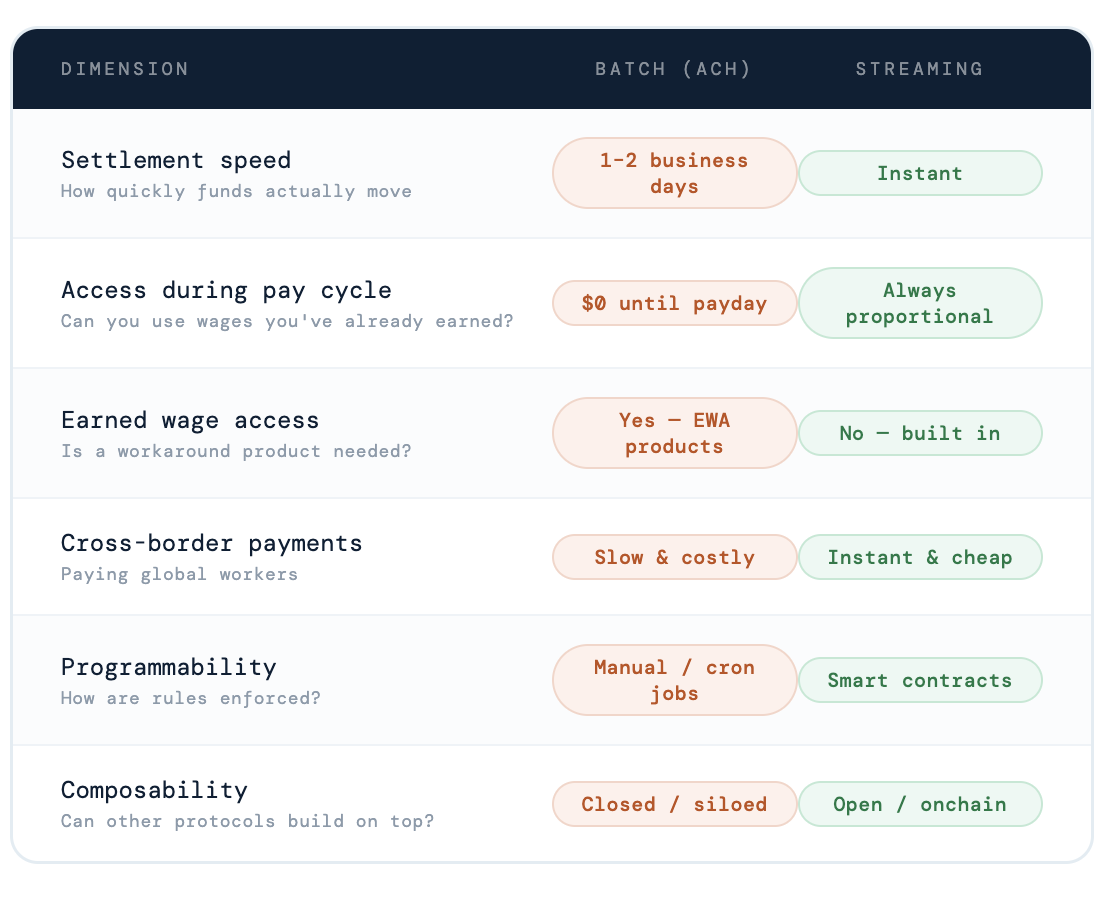
Historically, what’s been missing is a settlement layer capable of supporting this kind of real-time global payout model at scale. High-performance networks like Monad have changed that reality. With stablecoins settling instantly and transaction costs low enough to support continuous interactions, payroll can start to behave less like a delayed disbursement and more like a live income balance.
For payroll platforms already exploring stablecoin payouts, streaming offers a path toward rethinking payroll as a programmable system rather than a periodic transfer.
That doesn’t have to be the case anymore.